15 October 2026
AI automation for Odisha MSMEs: 7 practical, low-cost uses
Seven practical ways Odisha MSMEs can use AI automation today — enquiry replies, lead scoring, invoice reading, follow-ups, review replies, content drafts and daily reports — and how to start small.
6 min read
Odisha MSMEs can use AI automation today for seven practical, low-cost jobs: answering common WhatsApp enquiries, scoring leads, reading supplier invoices, sending follow-ups, drafting review replies, preparing Odia and English content, and sending a daily sales summary. The trick is to start with one repetitive task that eats staff hours, automate it well, and keep a person in charge of anything that reaches customers.
Whether you run a cashew processing unit in Ganjam, a steel fabrication shop near Rourkela, a coaching centre in Cuttack or a distributor in Bhubaneswar, the pattern is the same. Your team spends hours each day on work that follows rules: the same questions, the same data entry, the same reminders. That is exactly what AI and automation are good at.
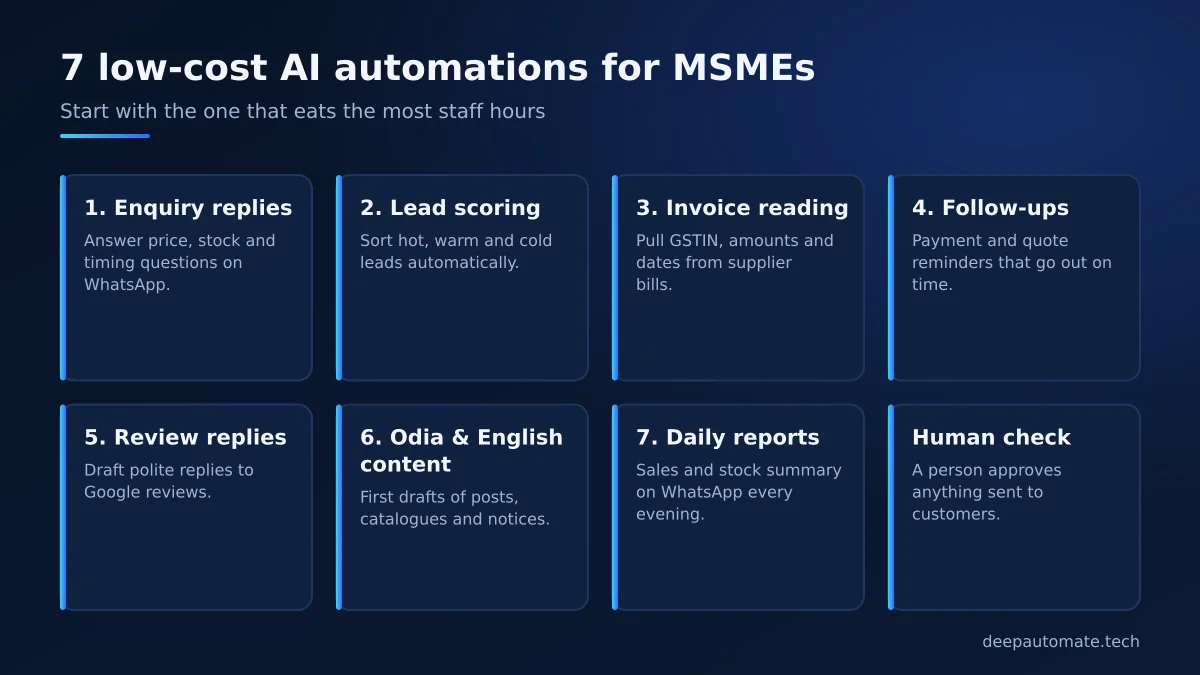
1. Answering common enquiries on WhatsApp
Most MSMEs get the same twenty questions again and again: price, stock, minimum order, delivery area, timings, GST invoice. An AI-assisted WhatsApp bot answers these from your own price list and FAQ, in English or Odia, at any hour. When a question goes beyond what it knows, it hands the chat to a person with a summary.
Good for: shops, distributors, coaching centres, clinics. Watch out for: the bot must answer only from your approved information, never guess prices.
See how this works in our WhatsApp bot demo, and read about setup in WhatsApp Business API for Odisha shops.

2. Lead scoring and routing
If enquiries arrive from your website, IndiaMART, Facebook ads and WhatsApp, someone has to decide who to call first. AI can read each enquiry, pull out the key details (product, quantity, location, urgency) and score it: hot, warm or cold. Hot leads go straight to a salesperson; others get an automatic, polite follow-up.
Try it in our AI lead extraction and scoring demo: paste a messy enquiry and watch it become a structured, scored lead.
3. Reading invoices and bills
Typing supplier bills into Tally or a spreadsheet is slow and error-prone. AI document reading can extract supplier name, GSTIN, invoice number, date, line items and totals from a photo or PDF, then put them into a sheet for your accountant to check. Your accountant still reviews it — but reviews instead of types.
4. Follow-ups that never get forgotten
Quotes that never get a follow-up, payments that are a week overdue, AMC renewals that slip by: these cost MSMEs real money. Automation can send polite reminders on WhatsApp or email on a schedule, stop when the customer pays or replies, and alert your team when someone needs a call.
5. Drafting replies to Google reviews
Replying to reviews helps your local reputation, but it is easy to fall behind. AI can draft a short, personal reply for each new review — thanking happy customers by name and acknowledging problems politely — for a staff member to approve and post. Combine this with the steps in our local SEO guide for Berhampur businesses.
6. First drafts of content in Odia and English
Product descriptions, festival greetings, notices for customers, social posts, simple brochures — AI can produce a decent first draft in both languages in seconds. A person who knows the business must edit it, especially Odia text, but the blank-page problem disappears.
7. A daily summary on WhatsApp
Owners often do not have a clear picture of the day until they sit with the books. A small automation can pull today's sales, payments received, pending orders and low-stock items from your billing system or sheet, and send the owner a short summary every evening. No new software for the owner to learn — just a message.
What these cost: comparing approaches
| Approach | Good for | Typical starting point |
|---|---|---|
| Off-the-shelf tools (chat assistants, sheet add-ons) | Trying ideas, one person using it | Monthly subscription |
| WhatsApp bot with AI answers | Enquiries, orders, bookings | From ₹30,000 (~$320) |
| Custom AI automation (documents, leads, reports, integrations) | Multi-step work across your systems | From ₹80,000 (~$840) |
Custom projects typically take 4–8 weeks. For the full list of plans, see our pricing page. For more ideas beyond these seven, read AI automation ideas for small businesses.
How to start without wasting money
Step 1: Write down where the hours go
For one week, ask each staff member to note repetitive tasks and roughly how long they take. You will quickly see two or three tasks that dominate.
Step 2: Pick one task with a clear measure
"Reply to enquiries faster" is vague. "Every WhatsApp enquiry gets a correct first reply, and staff only handle the ones the bot hands over" is measurable.
Step 3: Keep the data clean
AI is only as good as the information it uses. An up-to-date price list, product catalogue and FAQ matter more than which AI model you choose.
Step 4: Human in the loop
For anything with money, health, legal or reputation risk, have a person approve the output. Over time you can relax this where the automation proves reliable.
Step 5: Respect customer data
Send AI tools only the data they need. India's Digital Personal Data Protection Rules were notified in November 2025 and are being phased in over 12–18 months, so it is sensible to build consent, security and deletion into any new system now rather than retrofit it later.
A worked example: a distributor in Ganjam
Picture a mid-sized FMCG distributor near Berhampur serving a few hundred retailers. Every morning, retailers send orders as WhatsApp messages, voice notes and photos of handwritten lists. Two staff members type these into the billing software, then call retailers about unpaid bills in the afternoon.
A sensible automation plan for this business would be:
- Order capture first. AI reads incoming WhatsApp orders, matches item names against the product list (including local spellings), and prepares a draft order for a staff member to confirm.
- Payment reminders second. Once orders are flowing, overdue invoices trigger polite reminders with a UPI link, and only stubborn cases reach a person.
- Owner's evening summary third. Orders, collections and low stock in one WhatsApp message.
Each step is small, measurable and builds on the previous one. Staff move from typing to checking and calling the customers who need attention.
Common mistakes
- Buying a big platform before proving one use case.
- Letting a bot invent prices or promises.
- No one owning the automation after launch — rules and prices change, and someone must update them.
- Measuring "AI usage" instead of hours saved or extra orders.
Talk to us about your first automation
If you run an MSME in Odisha and want to know which task to automate first, message us on WhatsApp at +91 79788 39679 with a short description of your business and where staff spend the most time, or use our contact page. We work Monday to Saturday, 10am–7pm IST, from Berhampur.
Frequently asked questions
Is AI automation affordable for a small business in Odisha?
Yes, if you start with one narrow task. A single automation such as WhatsApp enquiry replies or invoice reading is far cheaper than a big "AI transformation". Our custom AI automation projects start from ₹80,000 (~$840); simpler WhatsApp bots start from ₹30,000 (~$320).
Will AI replace my staff?
For most MSMEs, no. AI takes over repetitive work like answering the same price question or typing invoice data, so staff can spend time on customers, quality and sales. Keep a person approving anything important.
Can AI tools understand Odia?
Modern AI models handle Odia text reasonably well, especially for understanding customer messages, but quality varies. Test with real messages from your customers and keep a human review step for anything sent out in Odia.
Is my business data safe with AI tools?
It depends on the tool and settings. Use business accounts with clear data terms, avoid sending unnecessary personal data, and keep customer data in systems you control. India's data protection rules are being phased in, so plan for consent and security now.
Where should an MSME start with AI automation?
List the tasks that take the most staff hours each week and are repetitive. Pick one with a clear success measure, automate it, measure the result for a month, then move to the next.